Commercial cleaning is evolving as artificial intelligence, automation and robotic equipment become more practical for professional cleaning environments.
At WDC Facility Services, we continue to explore technology that could support greater cleaning consistency, productivity and visibility across commercial, industrial and specialised facilities.
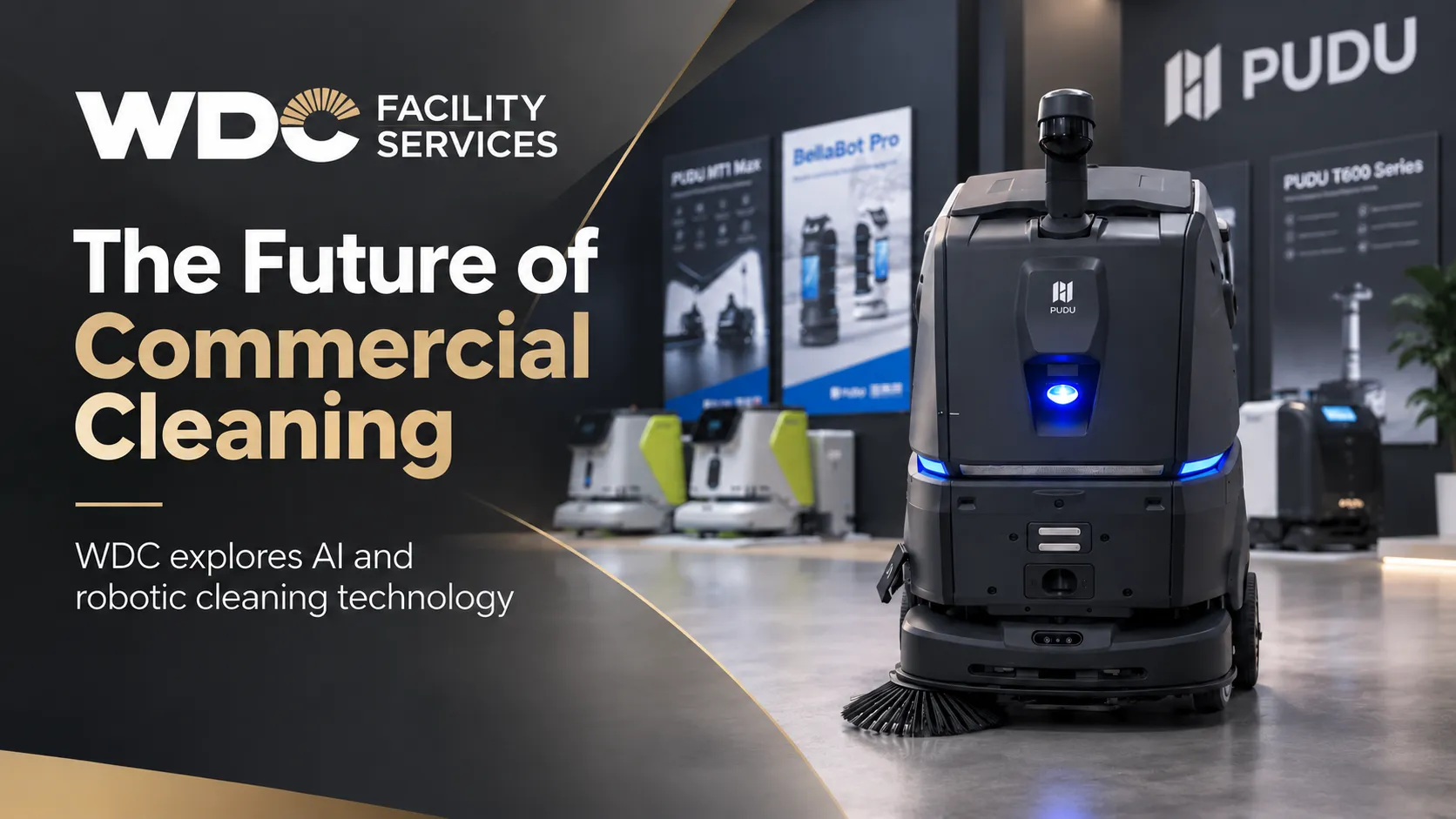
Recently, members of our management team visited the PUDU Robotics showroom to examine developments in AI-powered robotic cleaning and automated floor-cleaning systems.
The visit allowed us to see the machines operating firsthand and discuss where robotic cleaning performs well, where limitations remain, and how this technology could realistically support professional cleaning teams.
For WDC, the important question is not whether robots can replace cleaners. It is how skilled cleaners, intelligent equipment and digital systems can work together to deliver more consistent and effective cleaning outcomes.
What Stood Out to Us About Robotic Cleaning?
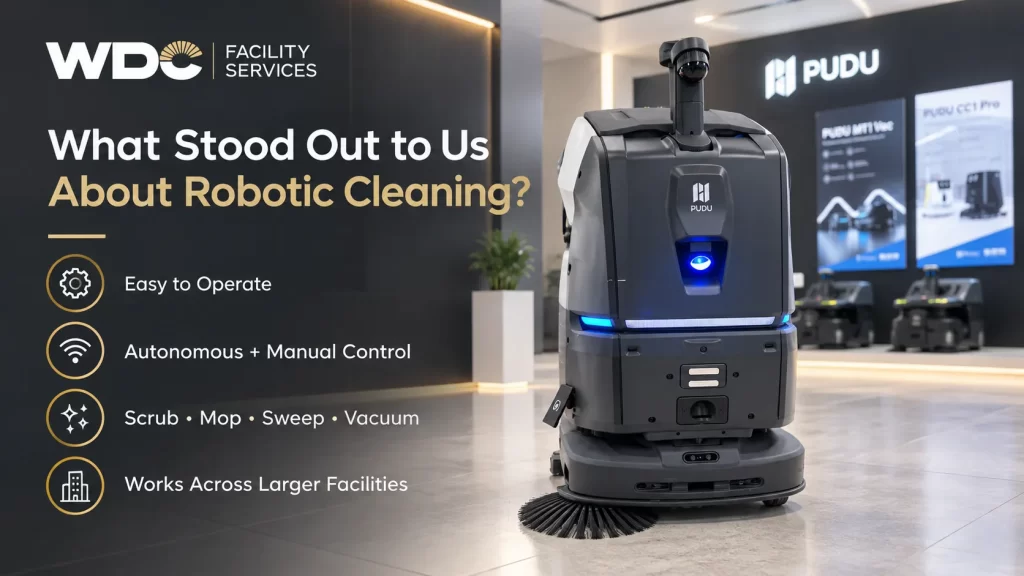
One of the first things that stood out was how straightforward the machines were to operate.
The ability to switch between autonomous and manual cleaning modes is particularly practical. If a cleaner needs to respond to a small spill or an area requiring immediate attention, they can take manual control, complete the task and then return the machine to its automated cleaning program.
A small spot-cleaning task therefore does not necessarily require a new cleaning map or automated route.
We also explored how robotic cleaning systems can handle different floor-cleaning tasks, including:
- Hard-floor scrubbing
- Mopping
- Sweeping
- Carpet vacuuming
We were also interested in how autonomous cleaning equipment can interact with the wider building environment, including automatic doors and lifts.
This becomes more relevant in larger commercial facilities, where robotic cleaning equipment may need to move between different areas or floors rather than remain within a single open space.
Why Different Facilities Need Different Cleaning Robots
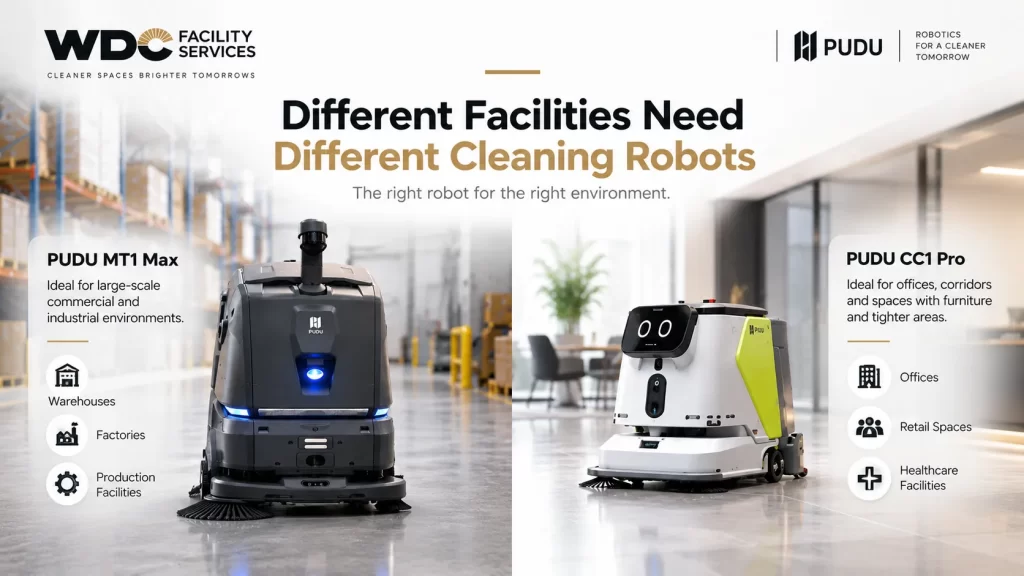
There is no single robotic cleaning machine that suits every commercial environment.
One of the larger machines we explored was the PUDU MT1 Max, designed for large-scale commercial and industrial environments.
Its larger capacity and ability to operate for extended periods make this type of equipment particularly relevant to warehouses, factories, production facilities and other sites with substantial open floor areas that require repetitive cleaning.
The PUDU CC1 Pro is designed for a different type of environment.
Its more compact footprint and manoeuvrability make it better suited to spaces with desks, furniture, corridors and tighter working areas. Its ability to perform multiple cleaning functions can also provide greater flexibility across everyday commercial environments.
Appearance is another practical consideration. When robotic equipment operates in visible staff- or customer-facing areas, it becomes part of the workplace environment rather than equipment that remains behind the scenes.
The main lesson from our visit was clear: robotic cleaning needs to be matched to the facility, floor type, layout and cleaning task.
The technology should be selected only after the site and its cleaning requirements are understood.
Smart Cleaning Is About More Than the Robot
The machine itself is only one part of an automated cleaning system.
The management technology behind the equipment was equally relevant to our team. Cleaning activity can be recorded and monitored digitally, giving teams greater visibility into what the machine has completed and how the cleaning program is progressing.
If the equipment encounters an operational issue or error, alerts can also be generated so the cleaning or facility management team can respond sooner.
A more connected cleaning system can combine three elements:
- Robotic equipment carrying out suitable cleaning tasks
- Digital systems recording and monitoring cleaning activity
- Cleaning and facility teams responding to issues and maintaining oversight
For facility managers, that level of oversight matters.
Automation is more useful when the people responsible for the site can still see what has been completed, identify problems and intervene when necessary.
Where Could Robotics Support GMP and Pharmaceutical Cleaning?
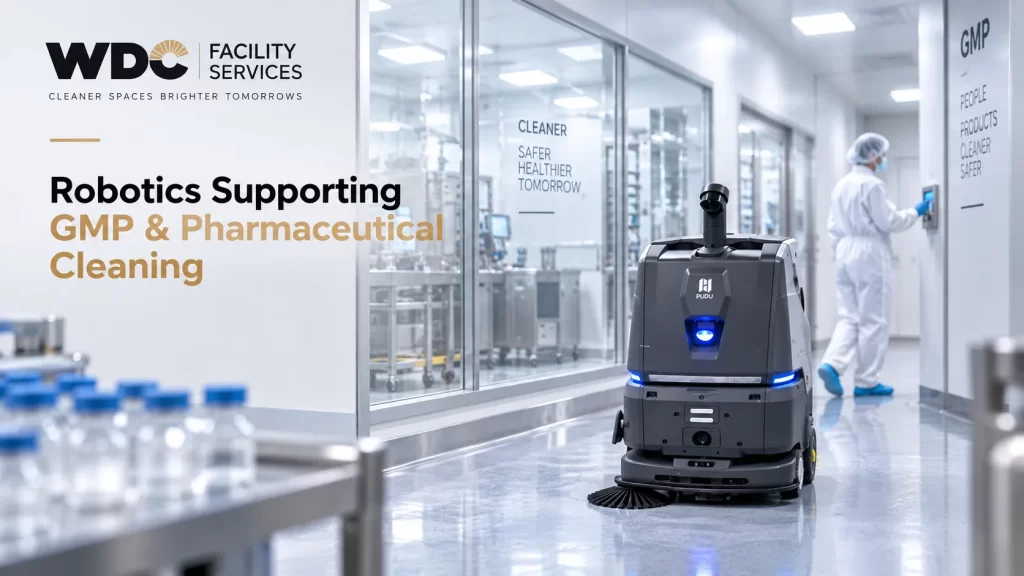
GMP, pharmaceutical and manufacturing facilities are important areas to explore because many contain large floor areas that require consistent, repetitive cleaning.
Suitable repetitive tasks are among the areas where robotic equipment could support a skilled cleaning team.
Instead of requiring trained cleaners to spend a large proportion of their time covering suitable open floor areas, robotic equipment may be able to handle part of that workload. Cleaners can then focus on areas that require greater manual control, detailed cleaning and human judgement.
Depending on the facility, these areas may include:
- Corners and floor edges
- Walls and doors
- Touchpoints
- Windows and glass
- Equipment surfaces
- Areas that robotic equipment cannot access effectively
The distinction is important.
Robotic cleaning is not a replacement for skilled specialist cleaners. It is a tool that may allow cleaners to spend more time on tasks where human judgement, manual control and detailed work are still required.
For specialised cleaning environments, this is a more practical way to consider the role of automation.
What Can We Learn From Existing Robotic Cleaning Applications?
During the visit, the PUDU team shared examples of its robotic technology being used across commercial environments and by recognised brands in Australia.
Seeing how the equipment is being applied outside the showroom gave our management team useful context on where robotic cleaning is already being introduced and how organisations are approaching implementation.
We also discussed the support required to introduce the equipment, including installation, implementation and ongoing technical assistance.
This matters because robotic cleaning is not simply a matter of purchasing a machine and placing it on site.
The equipment needs to be configured for the environment, incorporated into the cleaning program and supported when operational or technical issues arise.
For facility management teams considering automation, implementation and ongoing support may therefore be just as important as the capabilities of the robot itself.
What Are the Current Limitations of Robotic Cleaning?
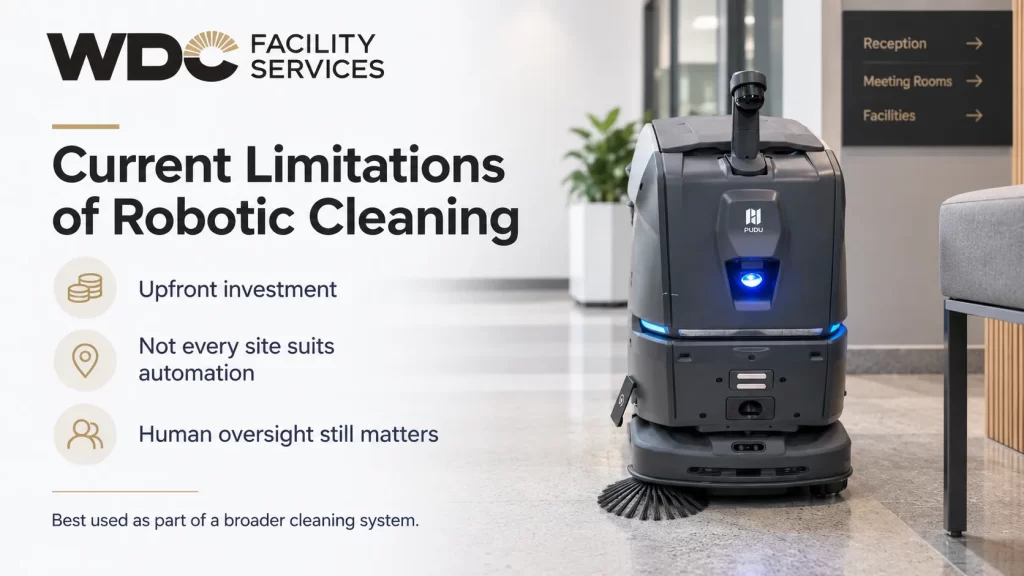
Robotic cleaning still has practical and commercial limitations.
The equipment requires an upfront investment, and not every building, floor layout or cleaning task is suitable for automation.
Robotic equipment is generally more practical where there is enough repetitive cleaning work to justify its use. Smaller, highly congested or detail-intensive environments may provide fewer opportunities for effective automation.
Human involvement also remains essential.
Cleaners still need to manage detailed surfaces, difficult access points, unexpected spills, changing site conditions and tasks that require judgement rather than repetition.
This is why we see robotic cleaning as one part of a broader cleaning system rather than a standalone solution.
People, Machinery and Technology: Where Commercial Cleaning Is Heading
Our visit reinforced our view that the future of commercial cleaning is likely to involve closer integration between people, machinery and digital technology.
Machines can take on suitable repetitive cleaning tasks. Digital platforms can provide greater visibility over cleaning activity. Skilled cleaners can focus more of their time on detailed work, exceptions and areas where human attention remains essential.
At WDC Facility Services, we are exploring opportunities to introduce robotic cleaning at suitable customer sites where the facility layout, cleaning scope and volume of repetitive floor work make automation operationally practical.
Robotic cleaning is no longer something we are simply observing from a distance.
It is technology we are actively evaluating to understand where it can genuinely improve the way commercial cleaning is delivered.